Architecture Drawing





Outdoor Swimming Pools
21 drawings
2009- 2015
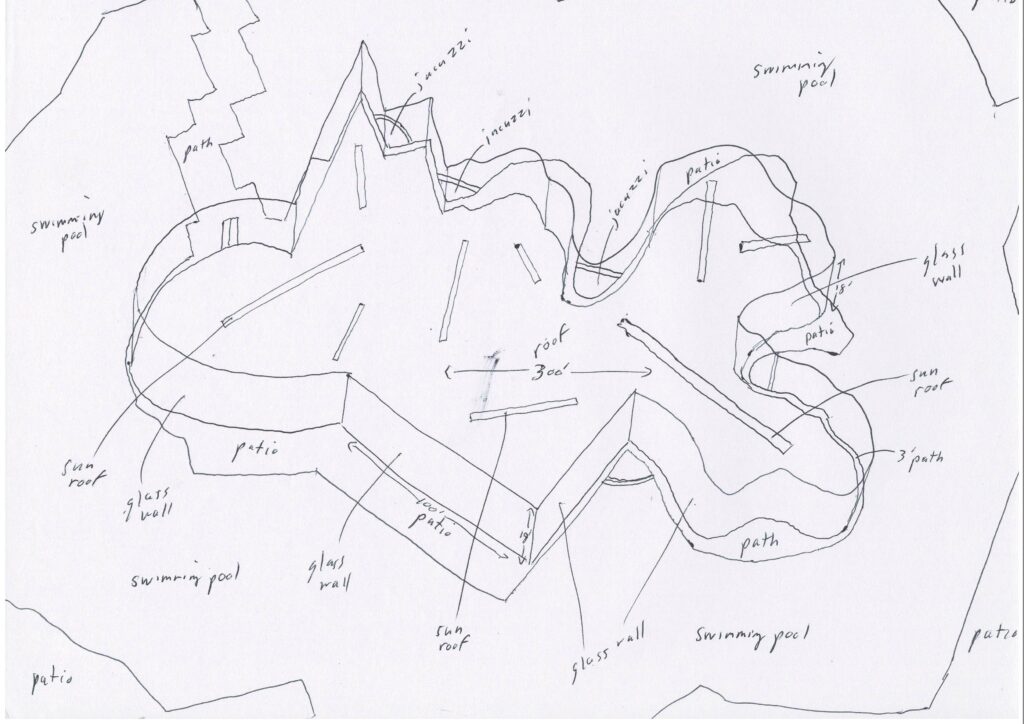
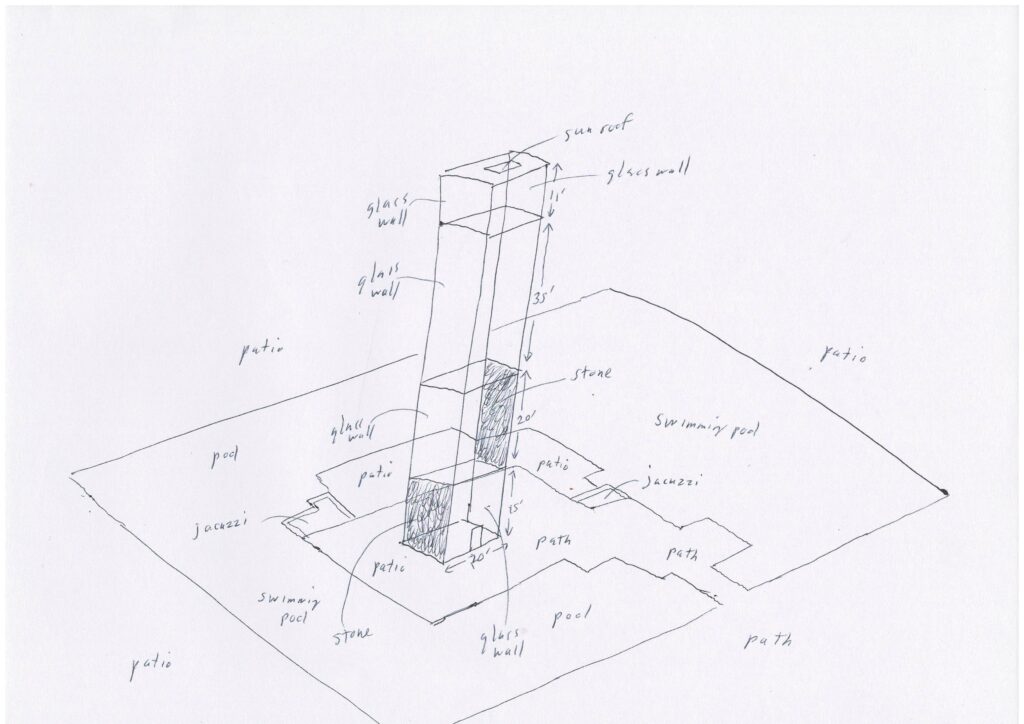
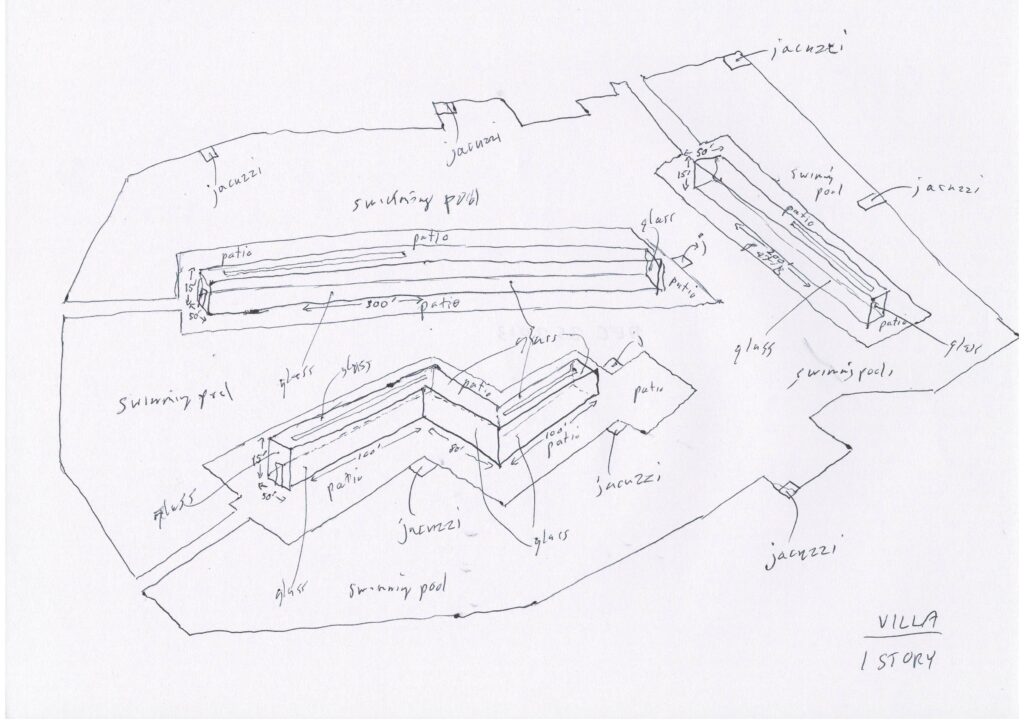
Outdoor Swimming pools are a series of pools designed
for urban centers. Each pool will be based on a philosophy
of being “safe” spaces from technology – ie cell phones,
T.V., computers, digital, and mass popular
culture – ie social media, popular movies and T.V.,
advertising, so people can get away from the internet,
social media, and video surveillance culture . The pools
will occupy a large area of 8 to 10 city blocks squared.
The pools will include Community Centre
type recreational facilities, to be therapeutic. There will
be lots of Nature, trees, plants, near the pool.
The pools will be self sufficient energy facilities, with its
own wind and solar power on the site or building. The
entire facility will have minimal video surveillance cameras,
and be oriented to non technology friendly ie. a place of
refuge and sanctuary from technology- no cell phones,
no video cameras, no photography cameras, no audio
devices, no devices, and no computers permitted within
the swimming pool facility or site. There will be check in
service for all cell phones and electronic devices, for free.
The marketing of the pool will be of a place to relax and
get away from everyday technology, from culture, from
fast paced urban living. The pool will emphasize
the beauty of simple recreational activities without tech-
nological interference. All the technology, will look
pre 1980s, ie -. no voice recognition machines, no facial recognition,
no voices from monitors, no invasive functioning tech,
no too complex tech function, rather simple dials and nobs
and simple traditional tech gadgetry. The only phones
will be pay phones, land lines in offices, a few cell phones
by security, senior management, or life guard staff for
emergencies only. There will be no photos or videos
allowed at all, except for special events, and very
controlled, limited, and minimal.
Recreation and play should inform the pools rules with
the greatest freedom. Some unique recreational programs,
may be creative, like one day a week a nude
swimming day for adults, or drinking alcohol party
swimming events, or rock music and swimming, or
classical music concerts and swimming, or weddings and
swimming, or halloween swimming events or a shark robots
in the pool swimming event.
The site will have many recreational facilities, 1. arcade
video games 2. music room 3. concert room 4. live music
spaces 5. sound mixing studio 6. dance club 7. massage spa rooms
8. spa 9. waterfall 10. water-slides 11. computer room
12. meditation rooms 13. yoga rooms 14. art rooms. 15.
dance rooms 16. beer garden 17. alcoholic bar. 18.
gardening room 19. movie theatres 20. insect zoo 21. science
exhibit room 22. telescope 23. planetarium 24. sailing
services 25. pool hall 26. bowling alley 26. life drawing
room 27. mental health center 28. wellness center 29.
ping pong 30. Indigenous wood carving center 31. theatre
32. theatre rooms 33. opra house 34. restaurants and
cafes – 10 different ones 35. archery room 36. cricket
hall 37 gym 38. gymnasium. 39 ballet school
In the winter, in certain cities, the pool can become
an ice rink. This ice rink will have flood lights so it can
be used in the evenings and be also past 12 pm. In fact,
the pool should strive to be open 24 hours 365 days a
year. This way, nightowl people can use it, and people
who enjoy the night, or are maybe bored at home at
2 am, or lonely, and can find a place to chill out. Imagine
being one of dozens of people, in a pool that is 700
feet by 1000 feet, at night, under the stars. That could
be a real special experience. Urban design should
afford such experiences.- ie. private moments in
public space.
There will be food and shopping area, with a free
buffet and kitchen. All food with be organic and health
food and affordable to a average person’s
income. There will be no GMO
and no genetic food and no corporate restaurants.
To build this pool, the city will have to find an industrial
area or neighbourhood to develop without gentrification
The general size of the pool should exceed 1000 feet
by 1000 feet, within a site of 10 by 10 square city blocks,
or larger. The larger the pool and site is, the more success
it will be for the community. It will be an architectural
landmark for the city. The expected daily attendance
during an hour may be 500 to 800 people, and a daily
attendance of 10,000 plus.
.
.
.
.
.
.
.
.
Villas
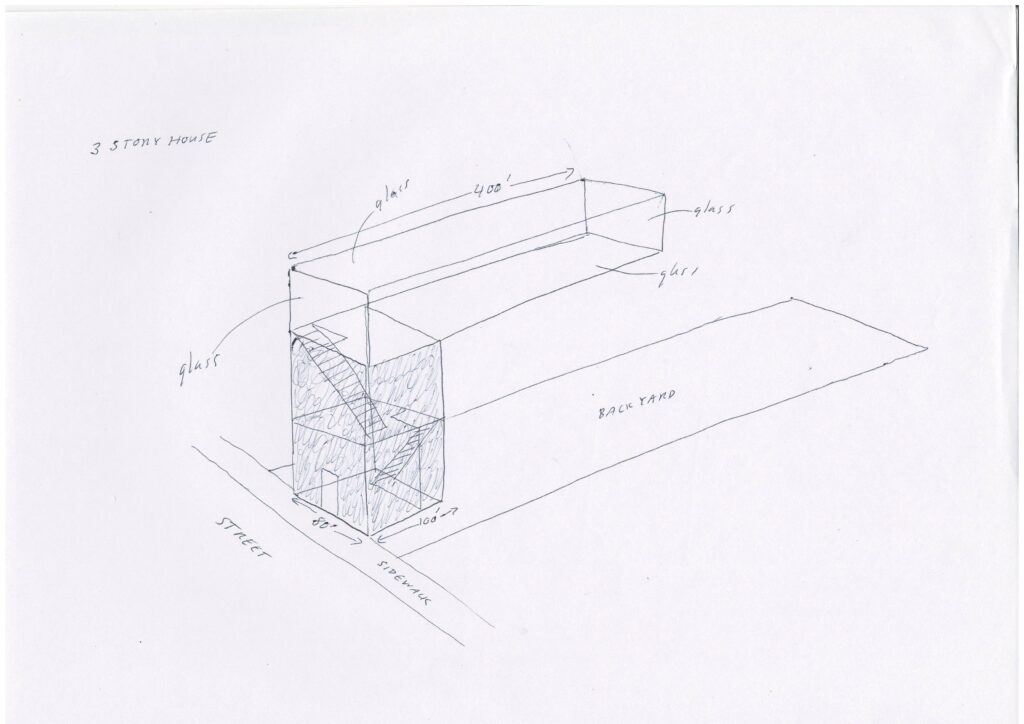
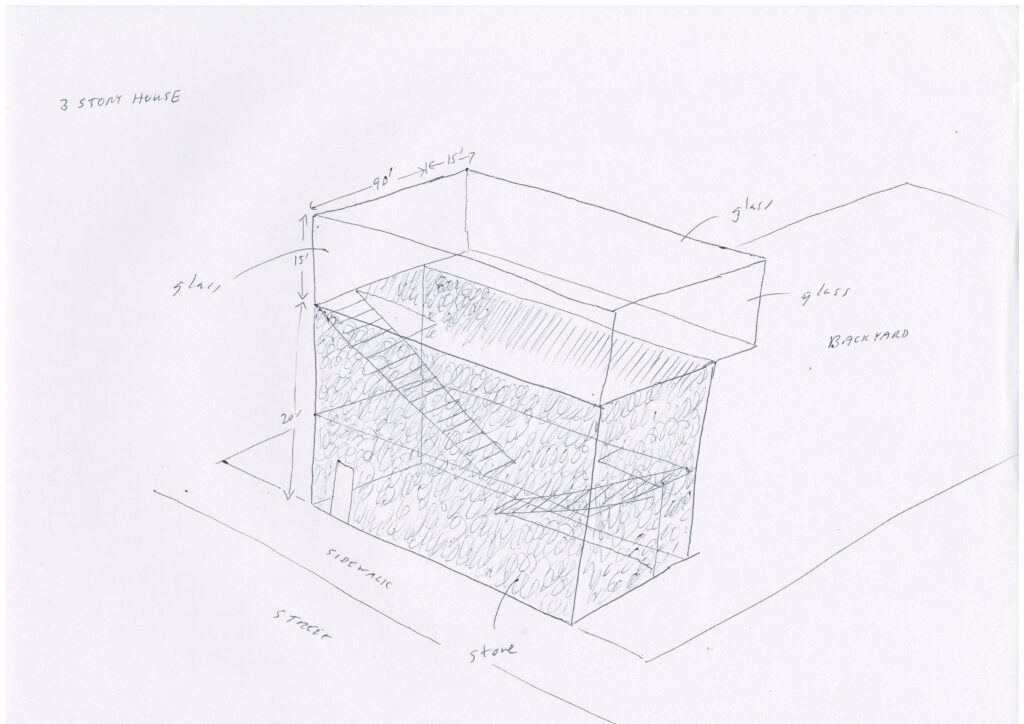
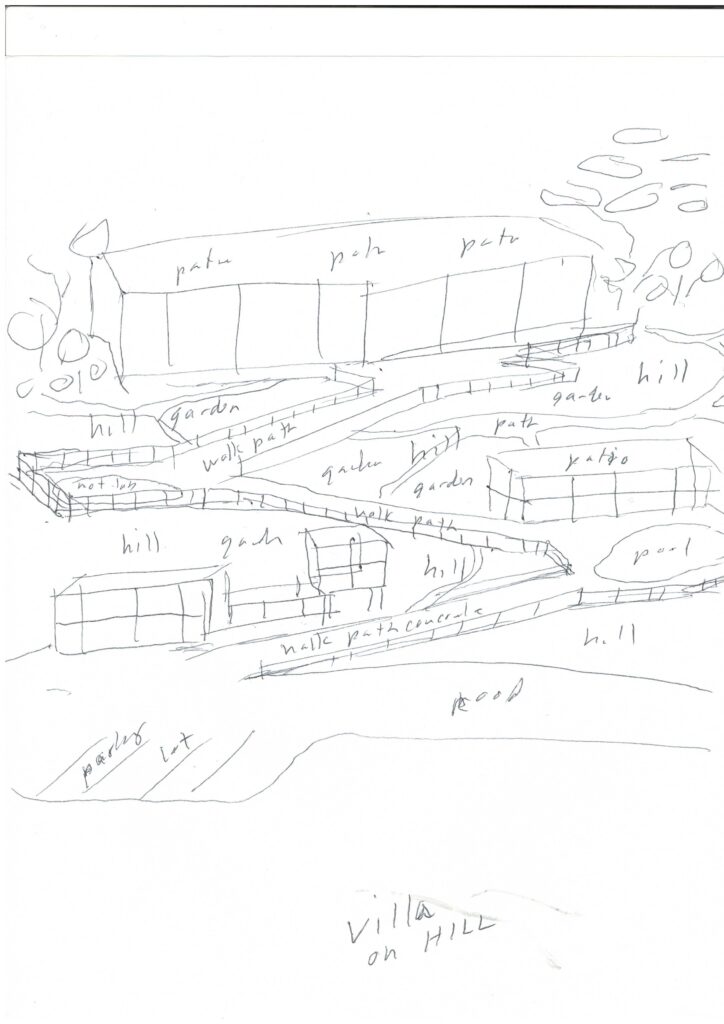


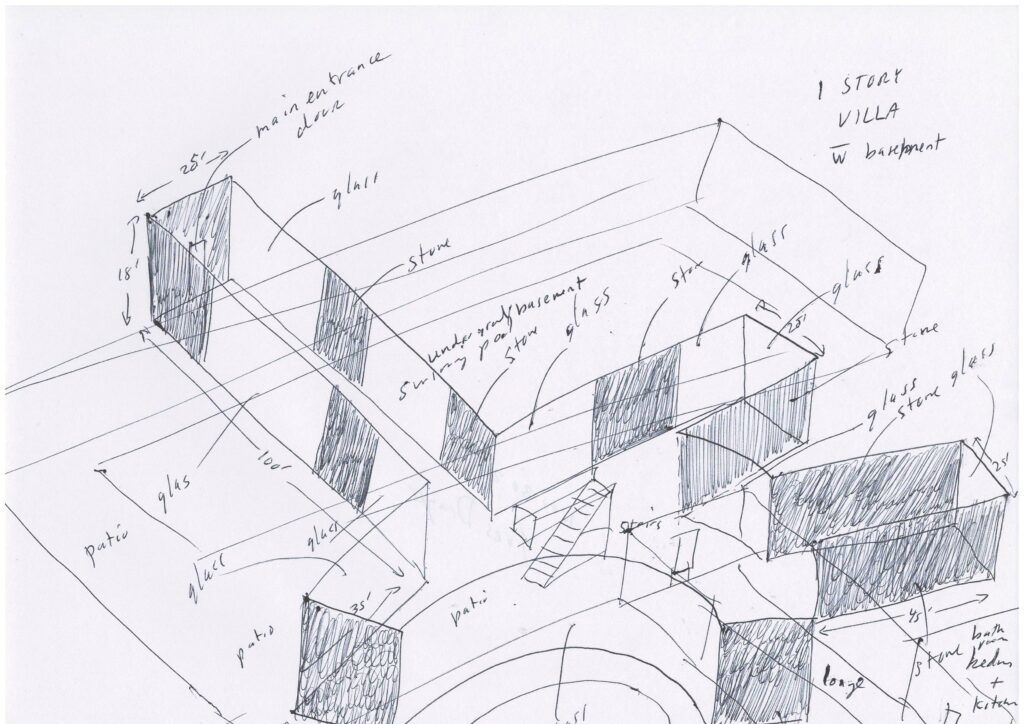









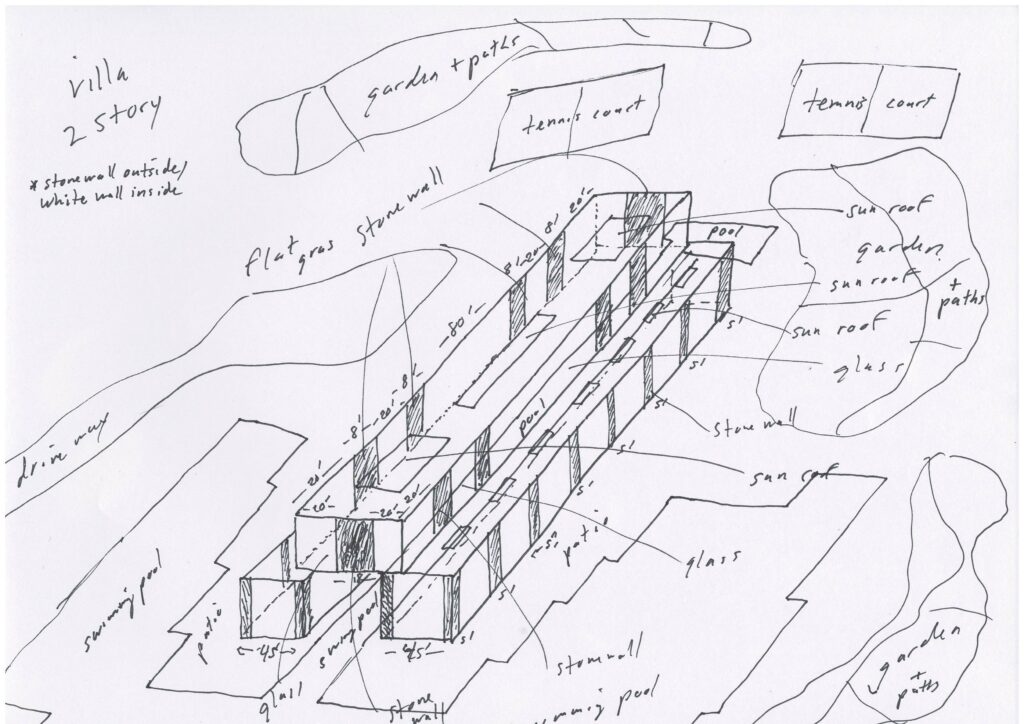
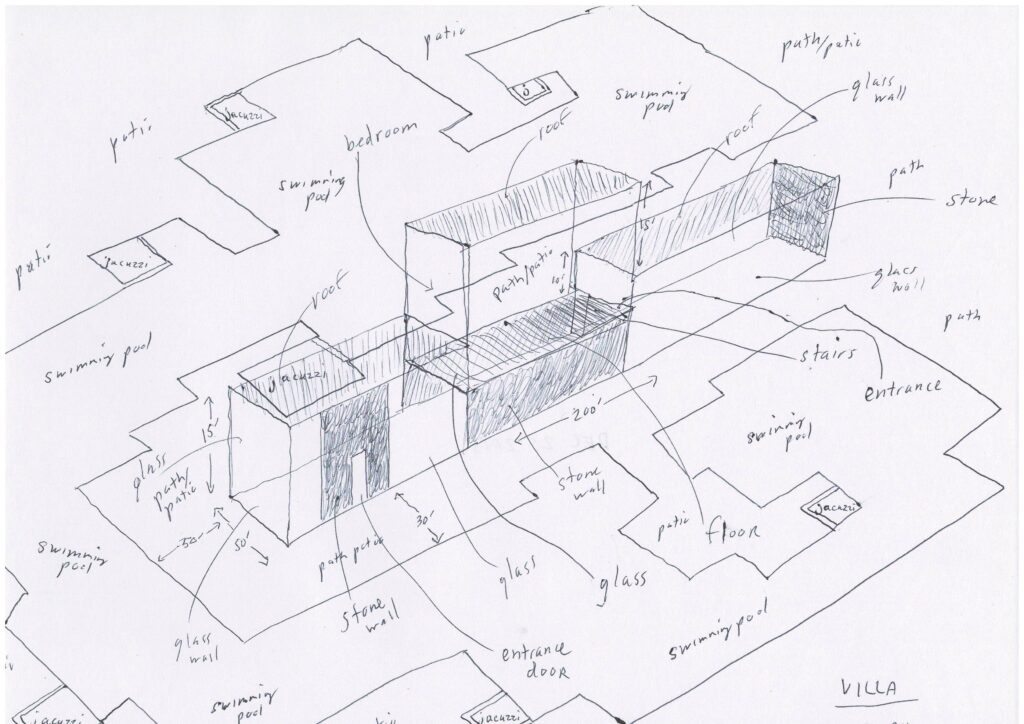
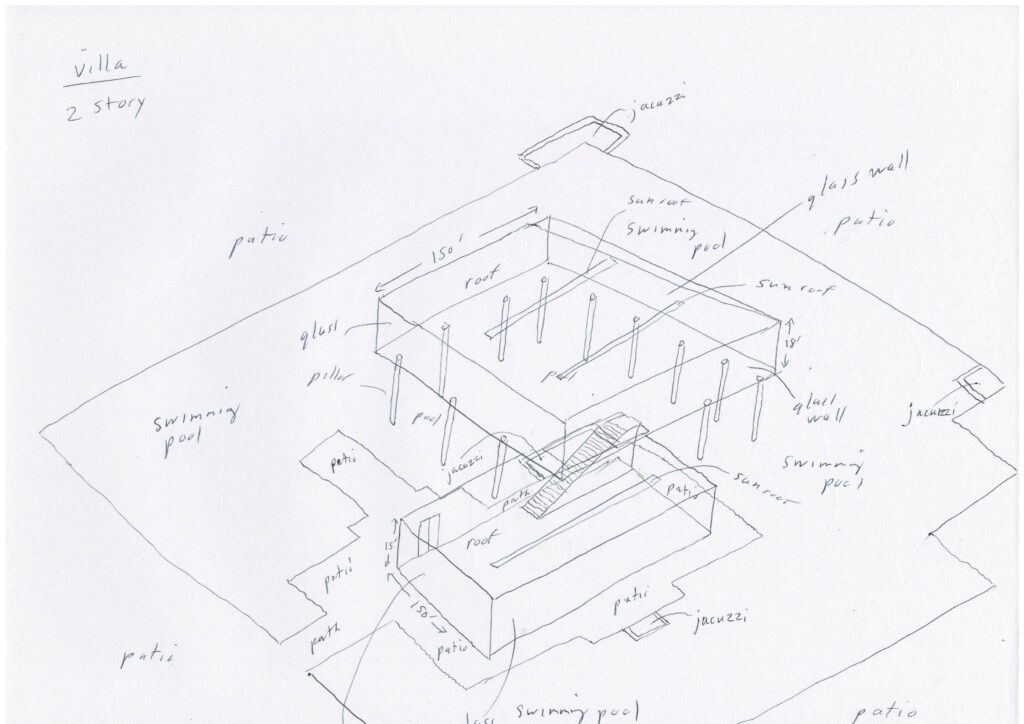
..Villas
40 drawings
2006 – 2015
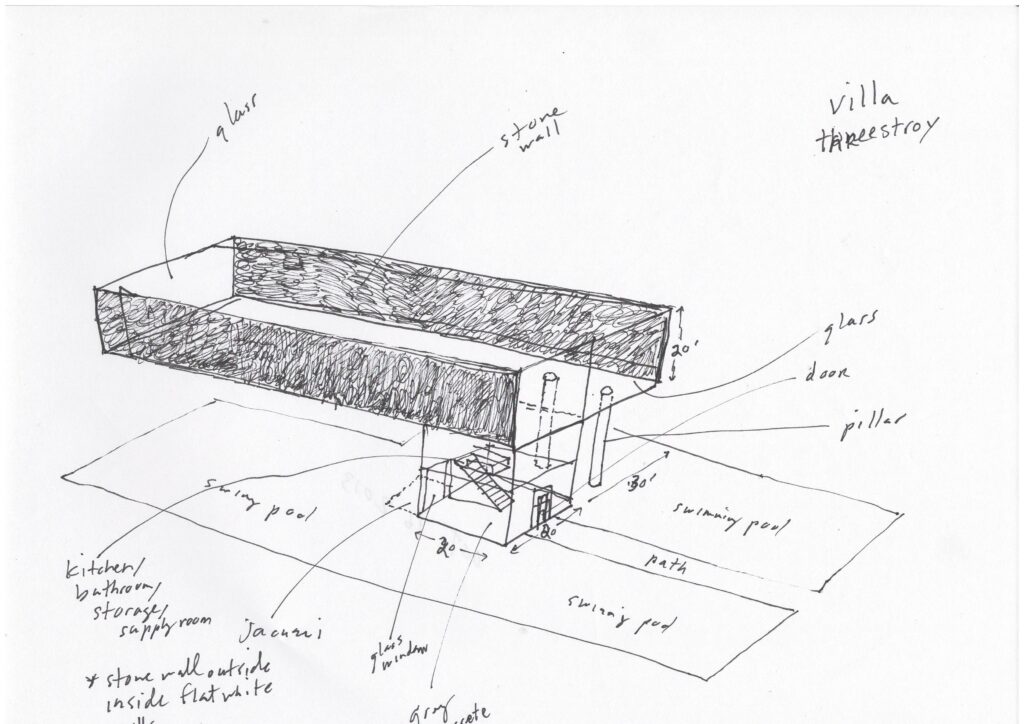
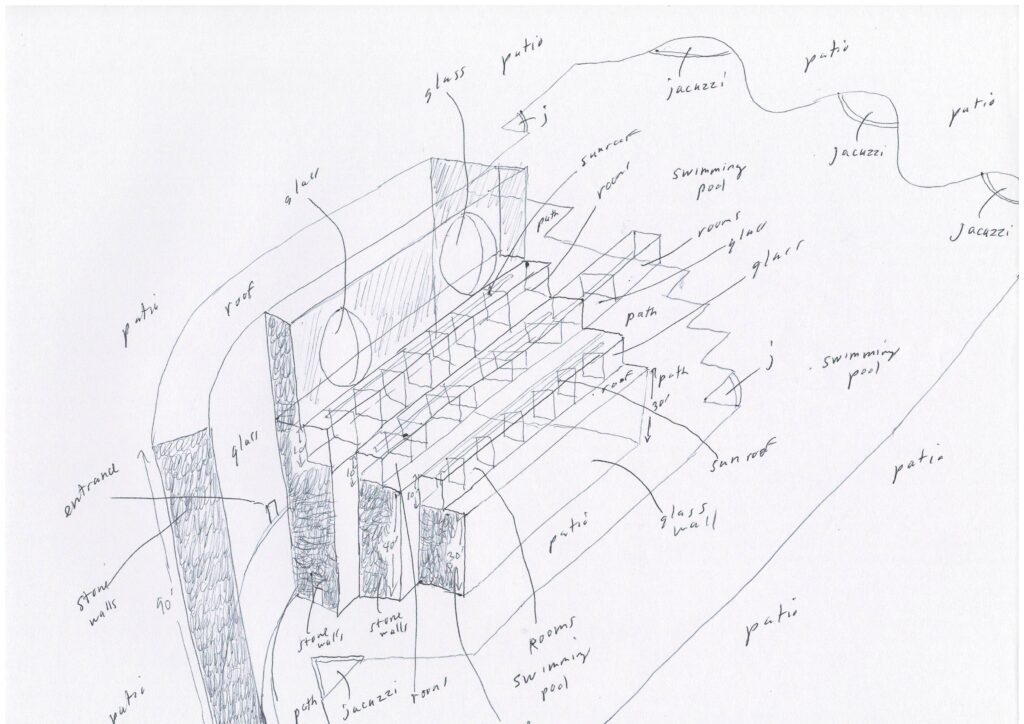
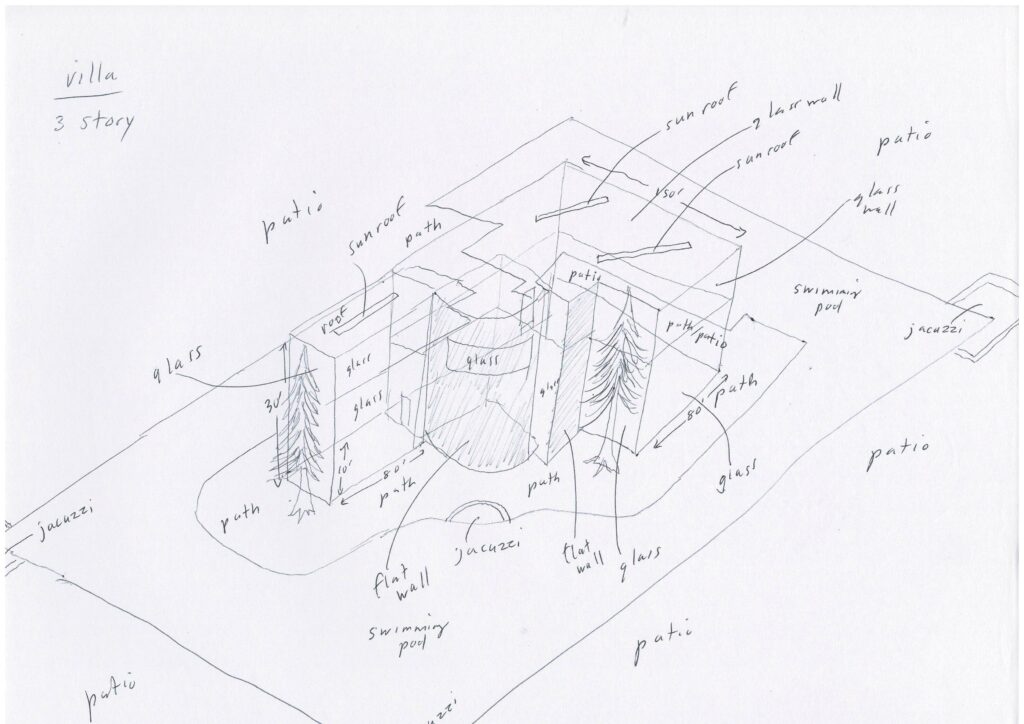
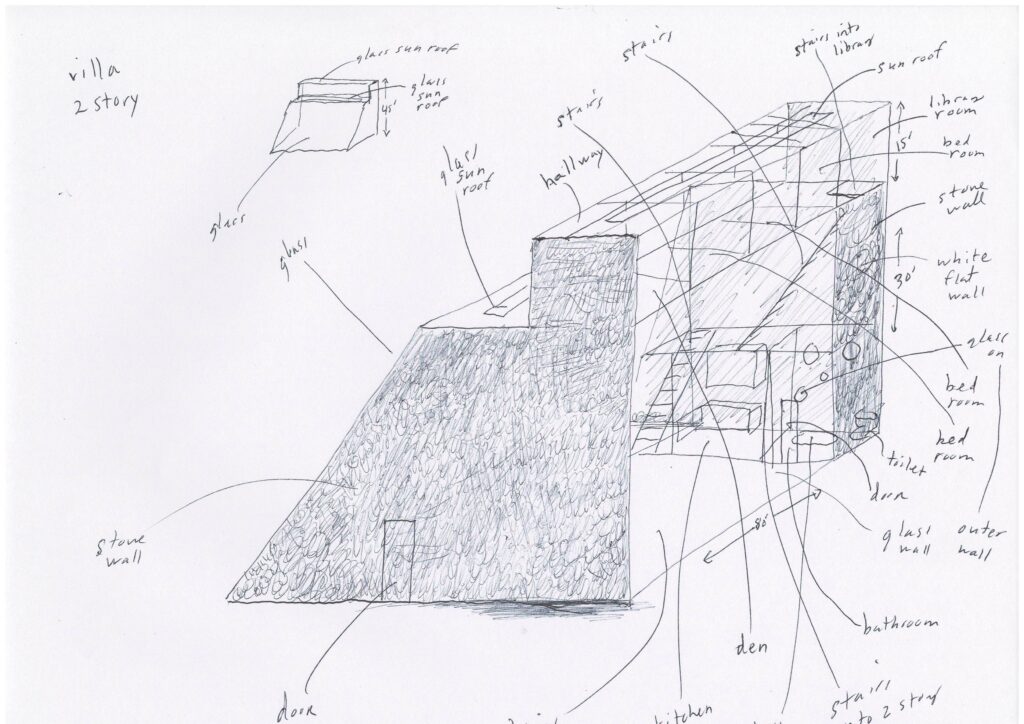
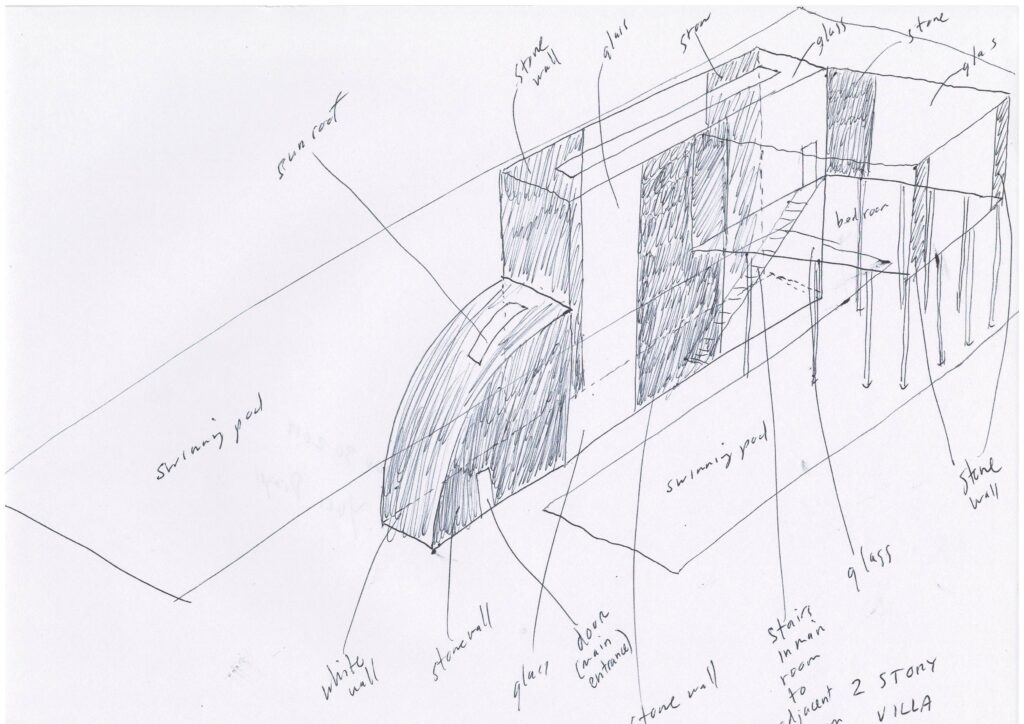
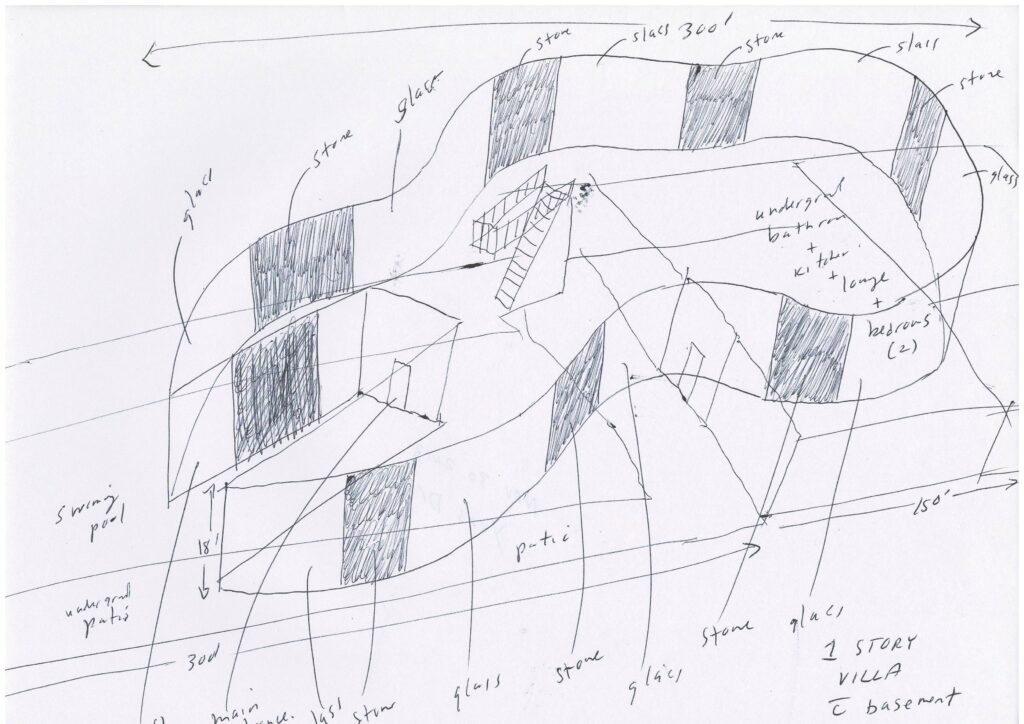
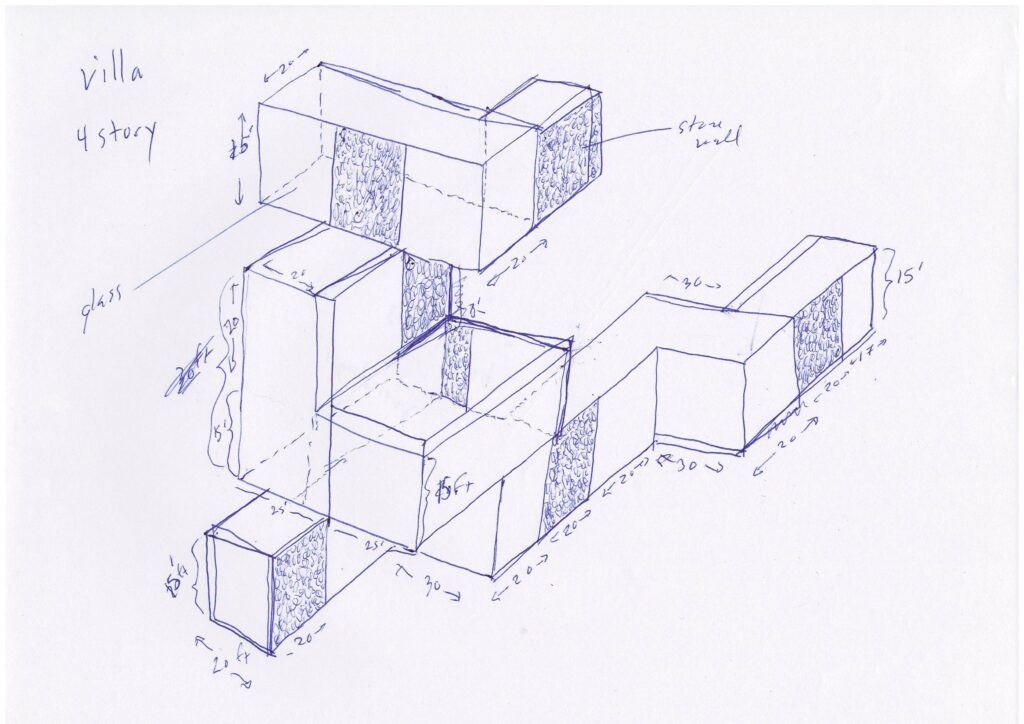
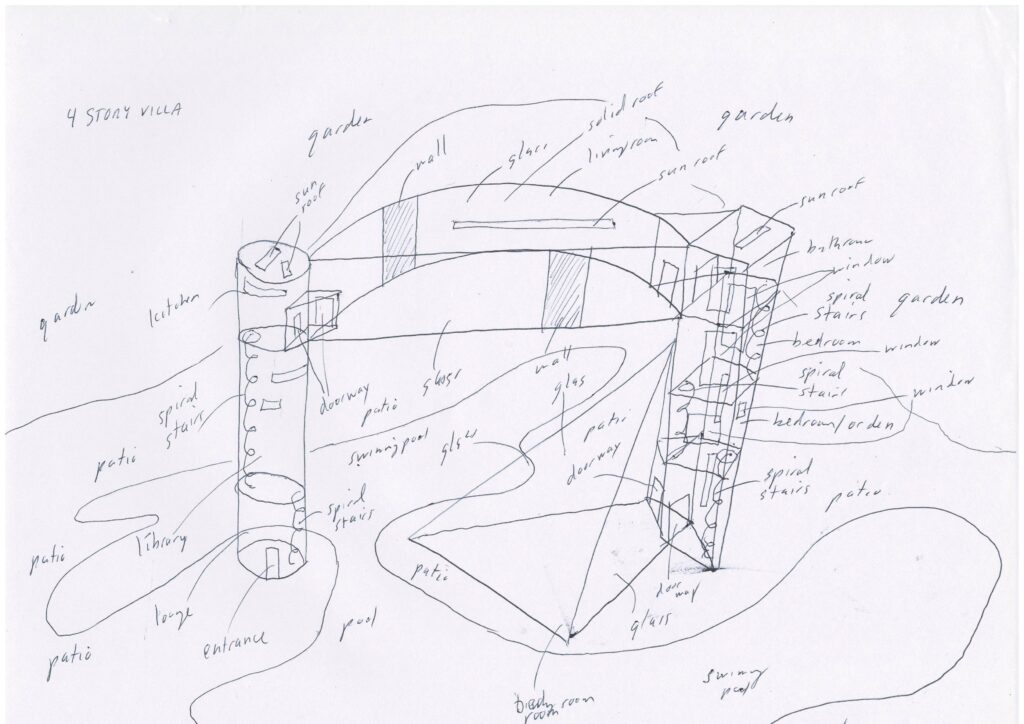
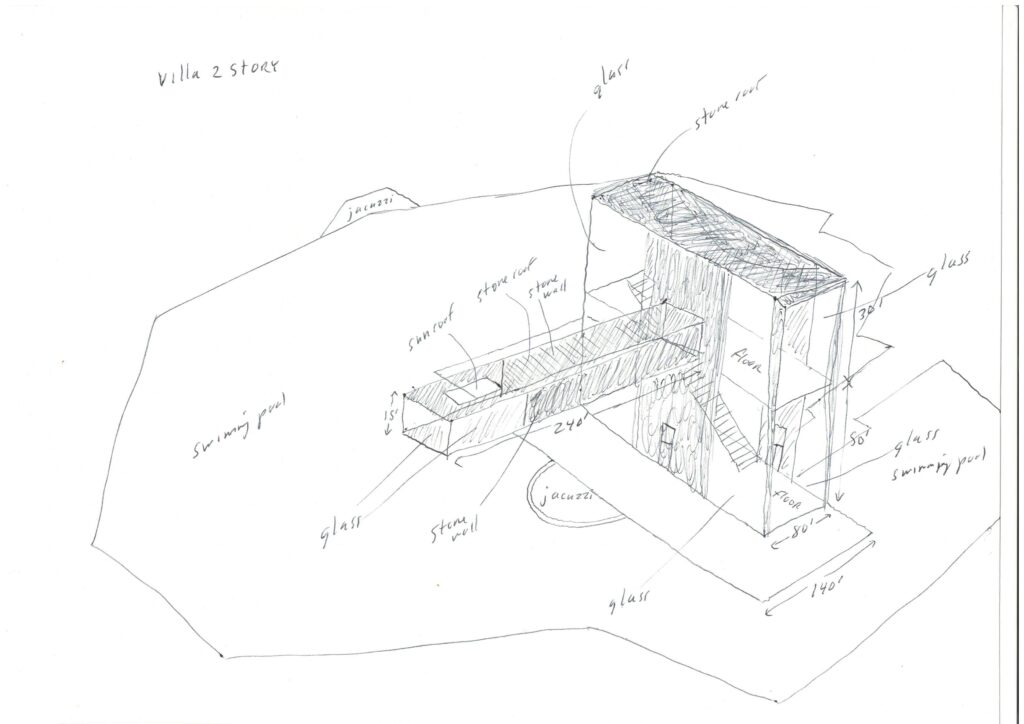
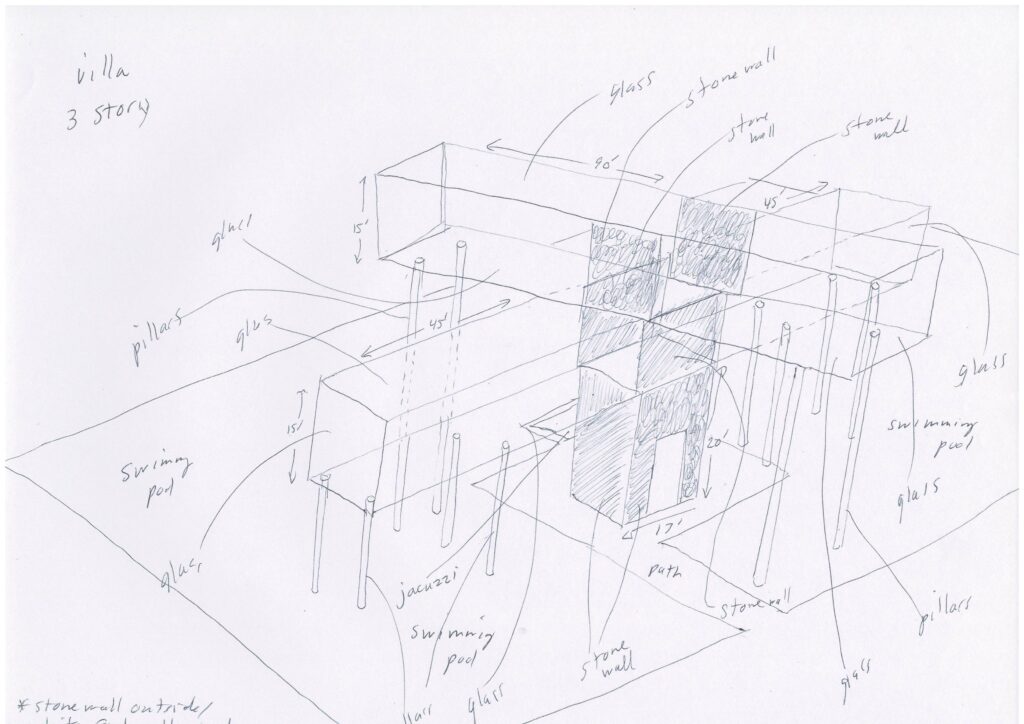
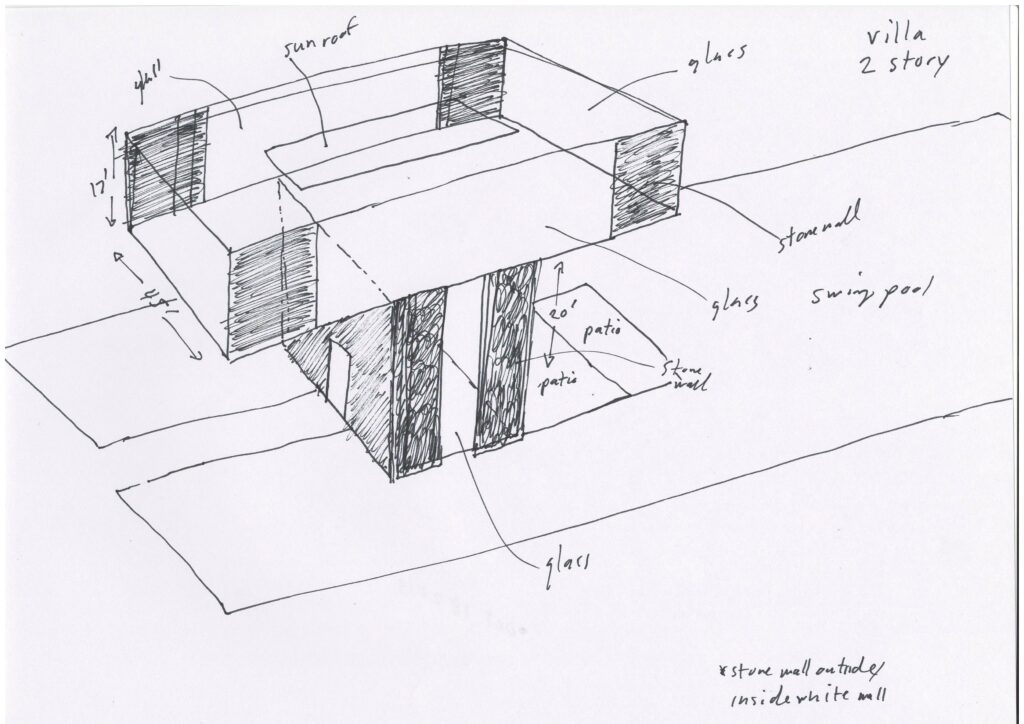
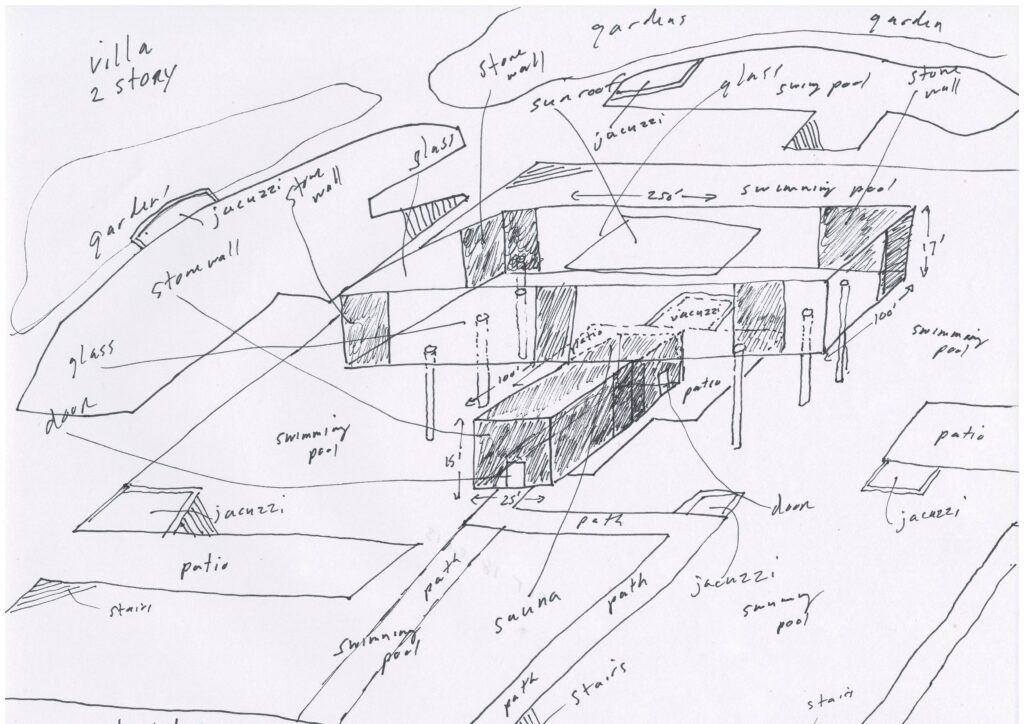
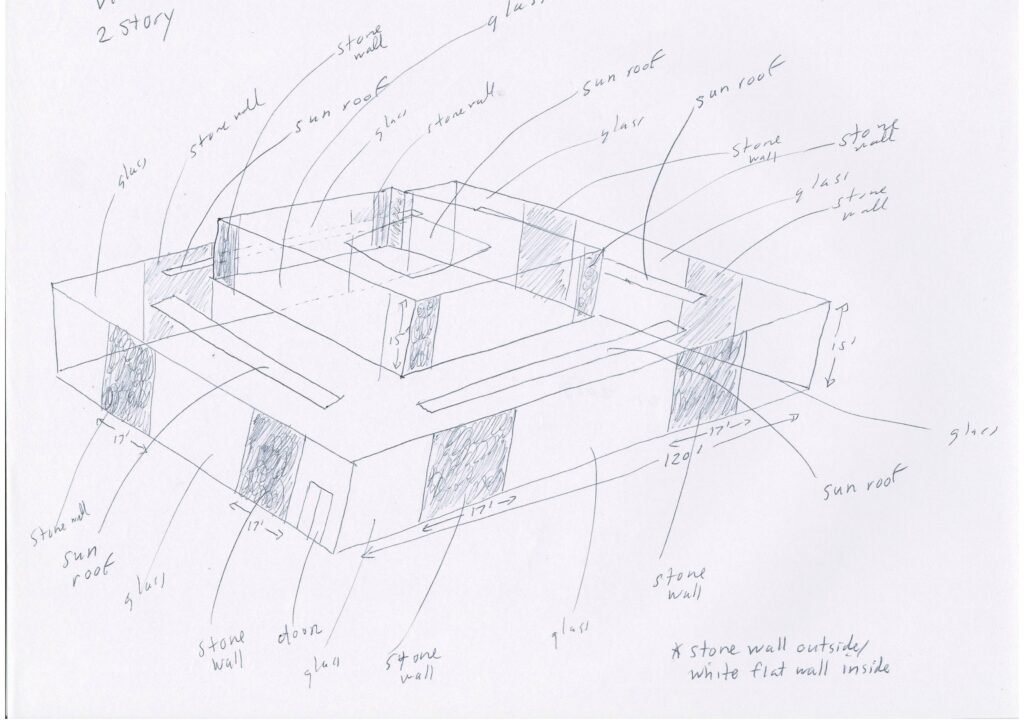
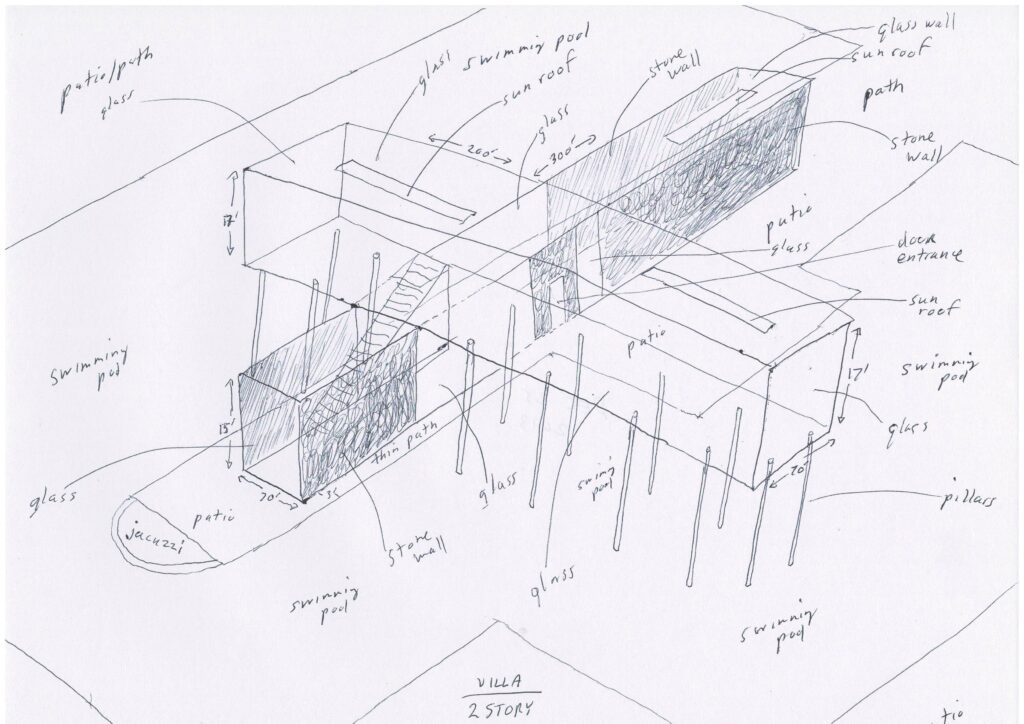
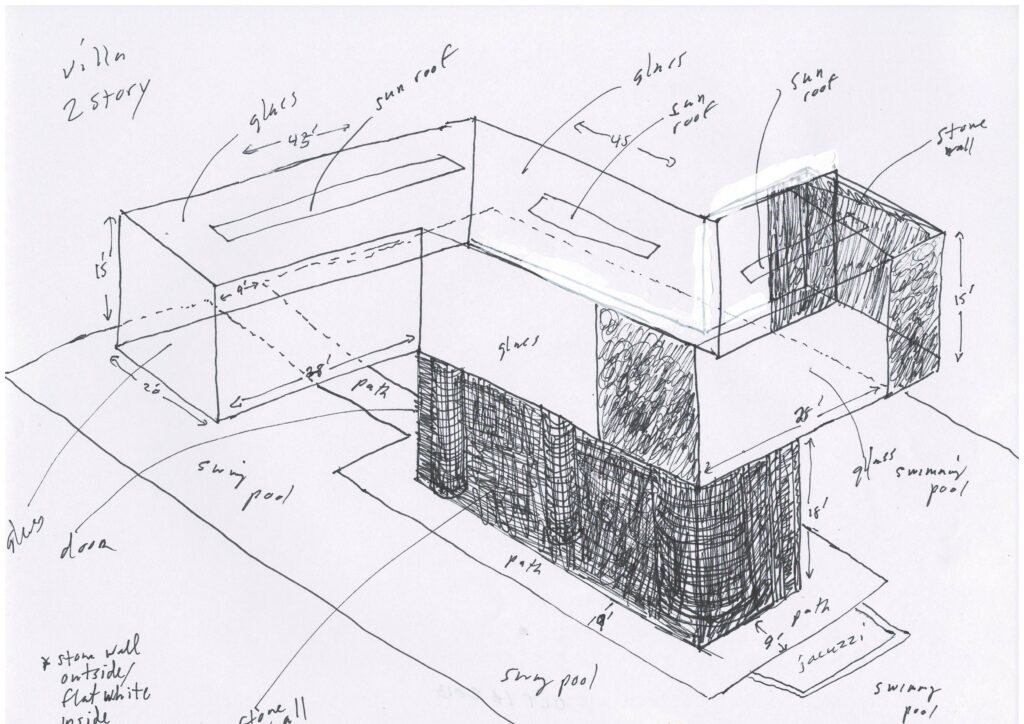
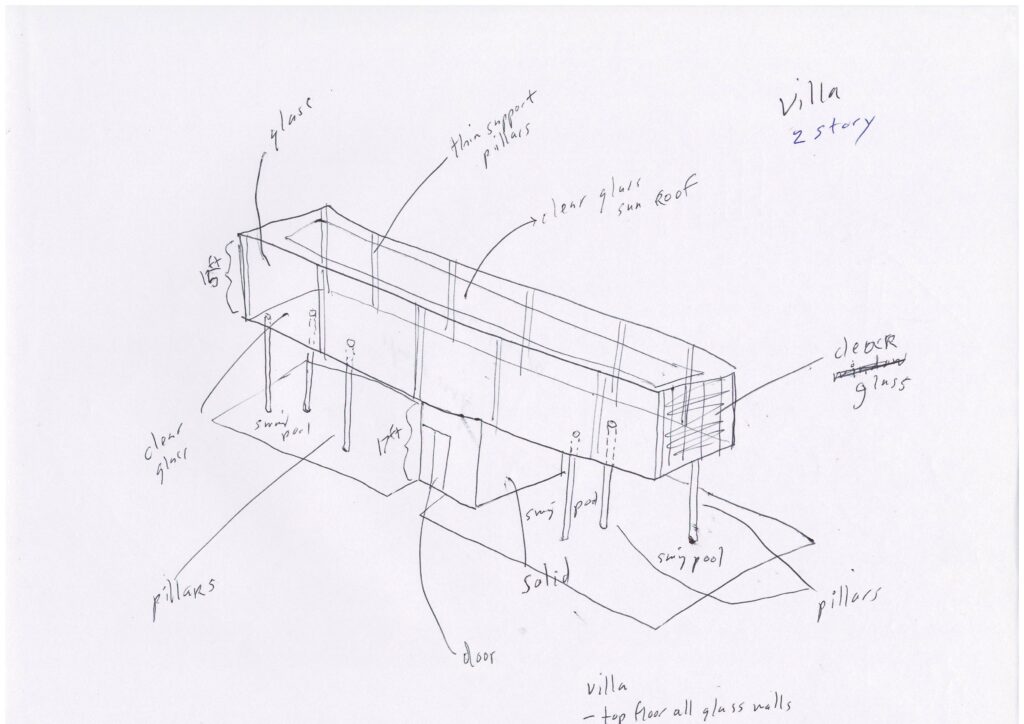
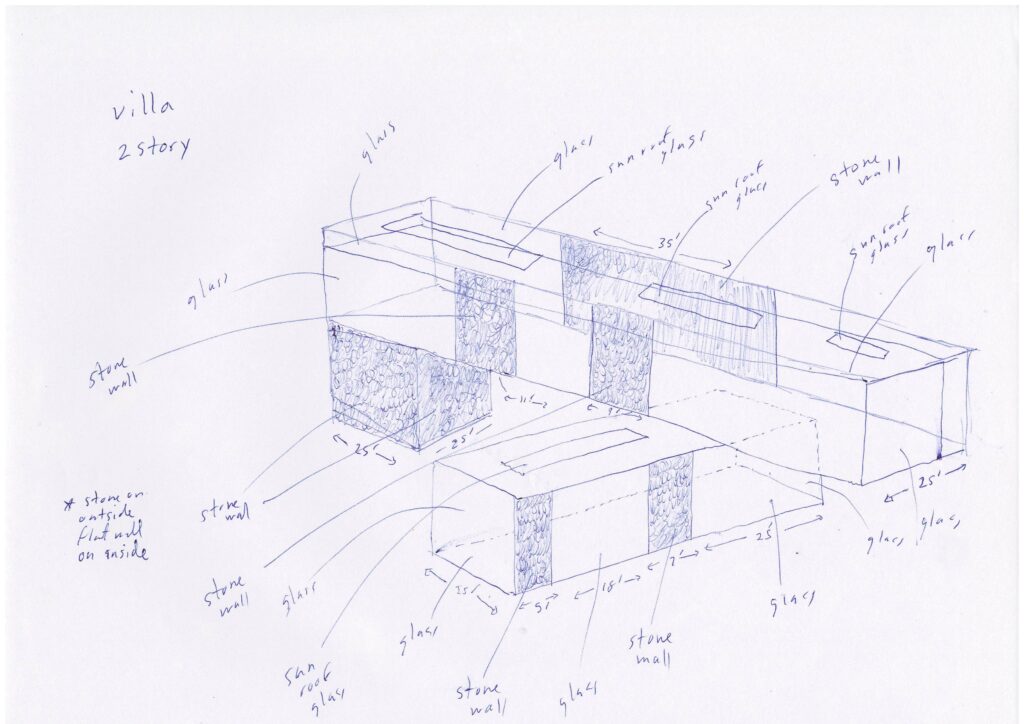
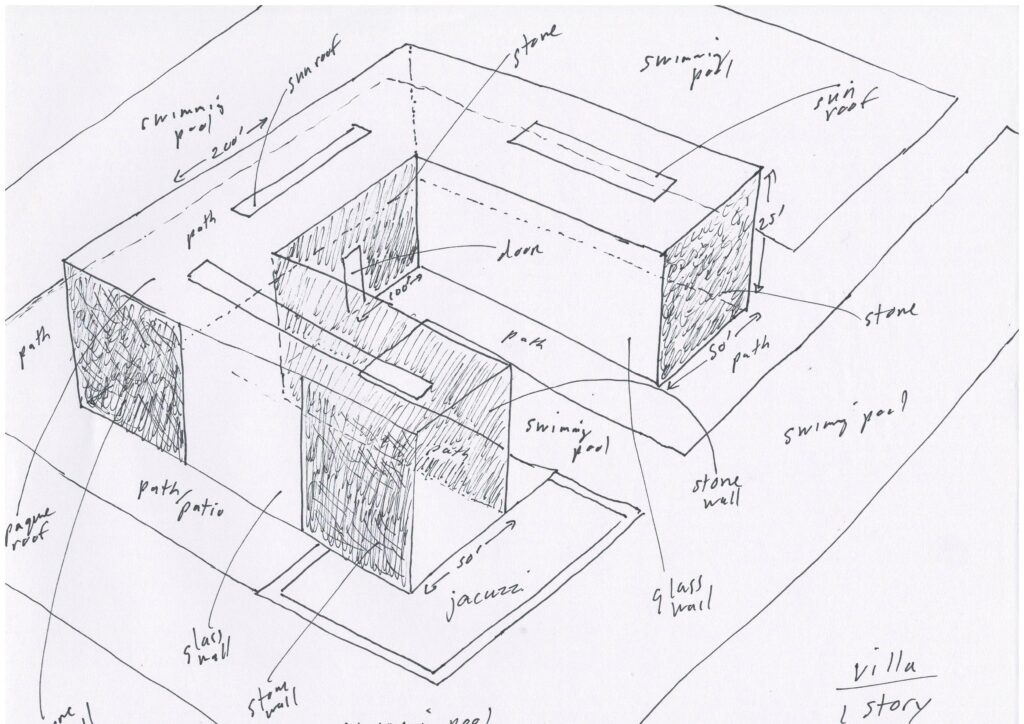
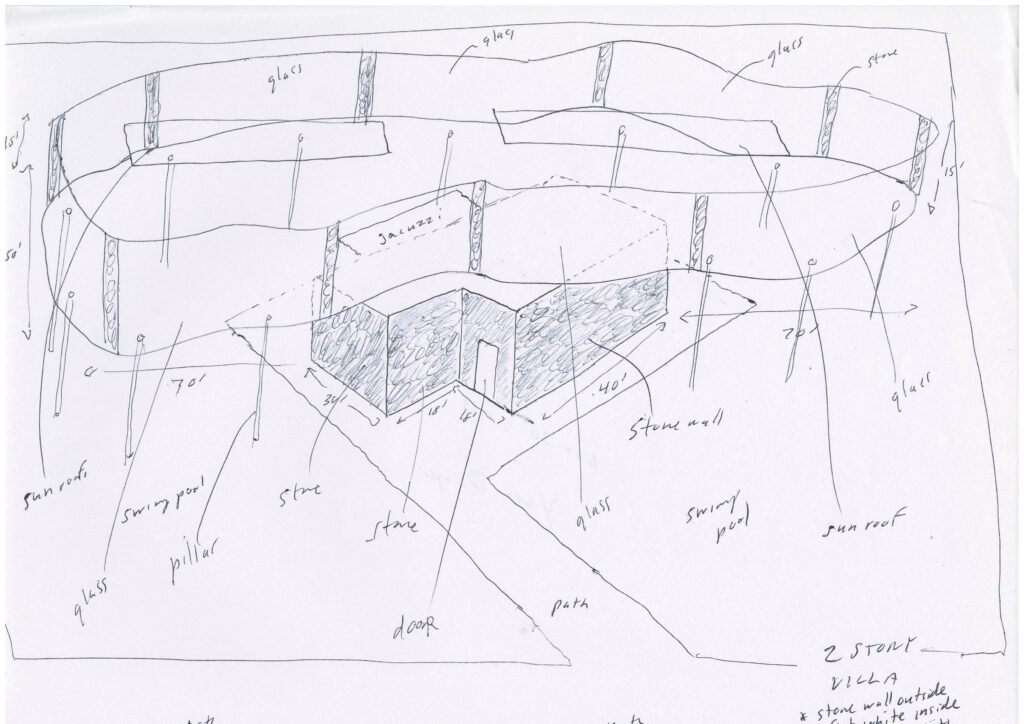
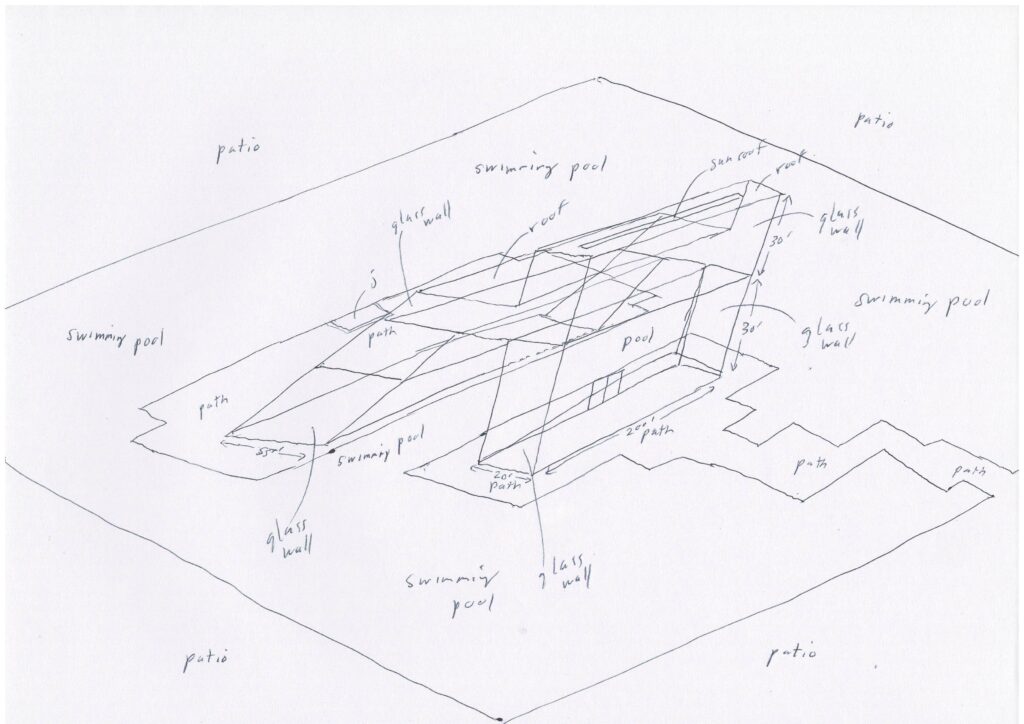
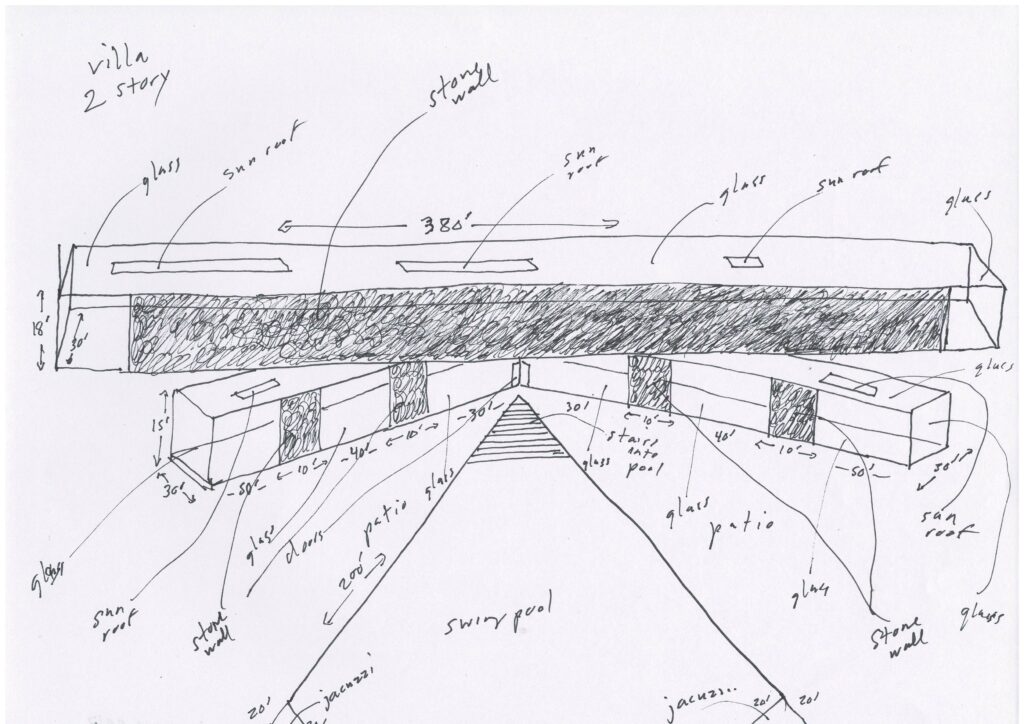
The series, Villa, stems from my fascination with Le Corbusier,
Mies van der Rohe, Frank Llyod Wright, Geritt Rietveld, and
the early Modernist villa. Minimalism, light, zen energy, and
shape, based on function/use over form/aesthetics, in the
context of design, is the foundation of Modern Architecture,
which seems to be a timeless and idealistic quest for poetry
in the pursuit of life, liberty, and happiness, reaching towards
meta consciousness, chi energy, mind/body relations, and
spirituality. My interest is not to be original, yet develop the
basic precepts and notions of a simple house- villa, in an urban
livability, collaborating with nature in terms of space/ light/
beauty. Ideally, Modern Architecture inspires one’s mood by
creating spaces which excite one’s living experience. In the
late nineties, I visited Frank Llyod Wright’s ‘ Falling Water’,
in Penn – sylvania. I was amazed at the intimacy of spaces,
the juxtaposition of materials, and how one moved through
the villa discovering new space/light in each room. Each room,
was a completed sculpture, and felt relaxing, in being a space
one could sit and read a book. There was a feeling, that each
room was a space to sit for hours, mostly because the propor-
tions were perfect, especially the windows were often large,
letting in the light and exterior, and the size of each wall felt
right- spatial relations. In the 2ooo’s, I visited Le Corbusier’s,
‘ Unite d’ Habitation’, and was also amazed with space, light,
and form, and the diversity of types of rooms- spaces. With
my villa, I am exploring the variations of one type of room –
an elevated room/cave with elongated shape and natural
light, with swimming pools as an architectural feature.
.
.
.
.
.
.
.
University Study Place
4 drawings
2012
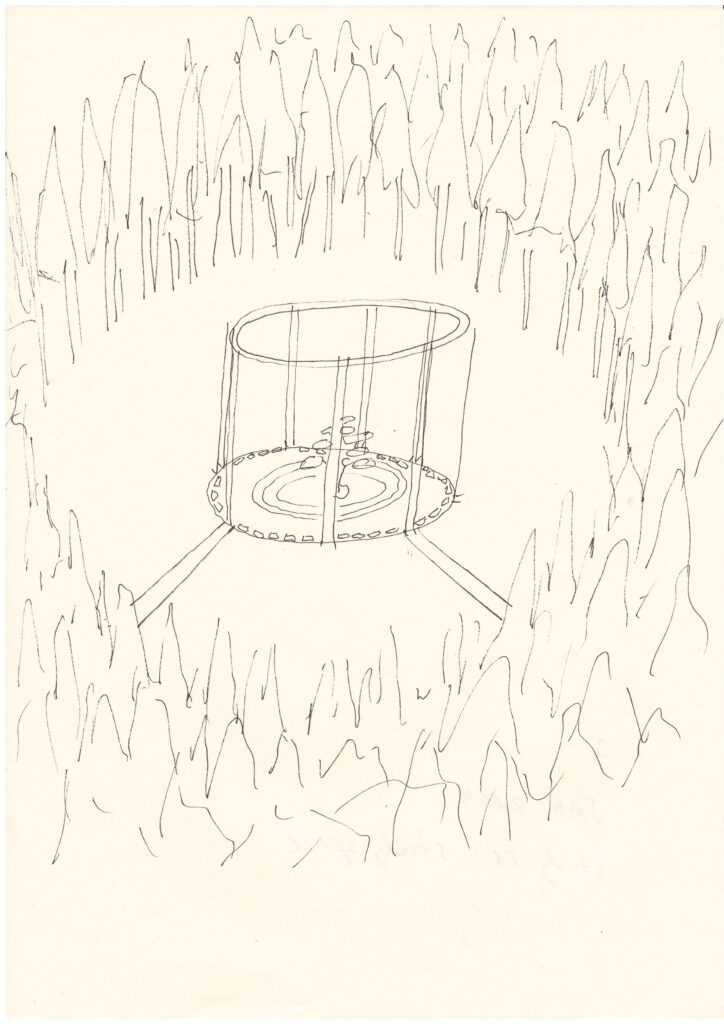
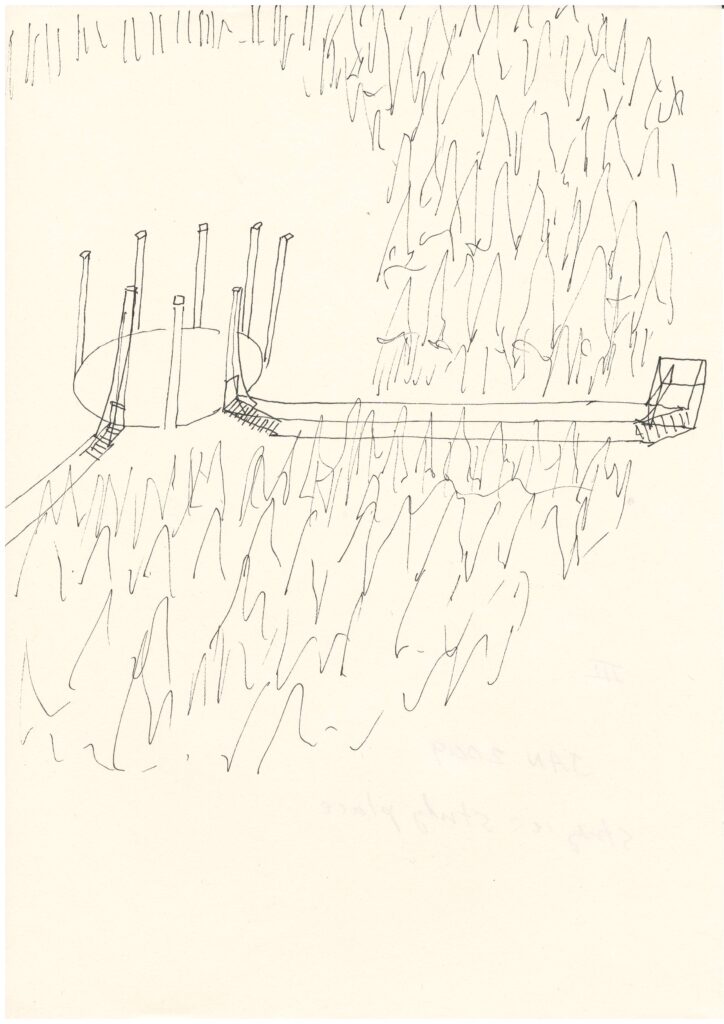
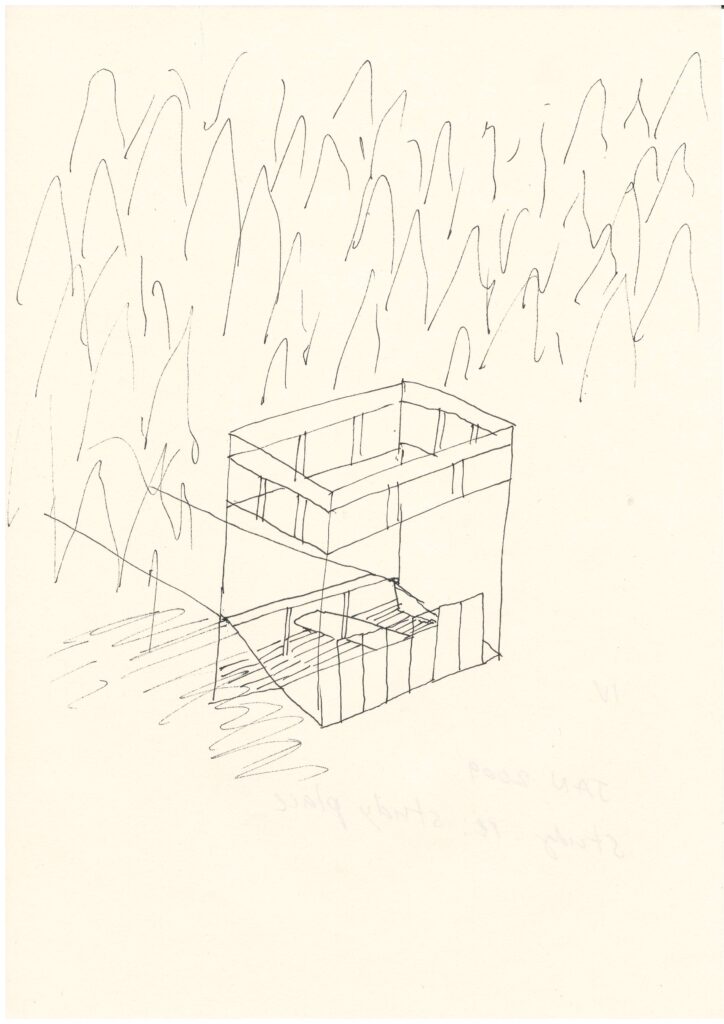
Study Place is a study hall for a university or college.
The study hall is to be located in the center of a small
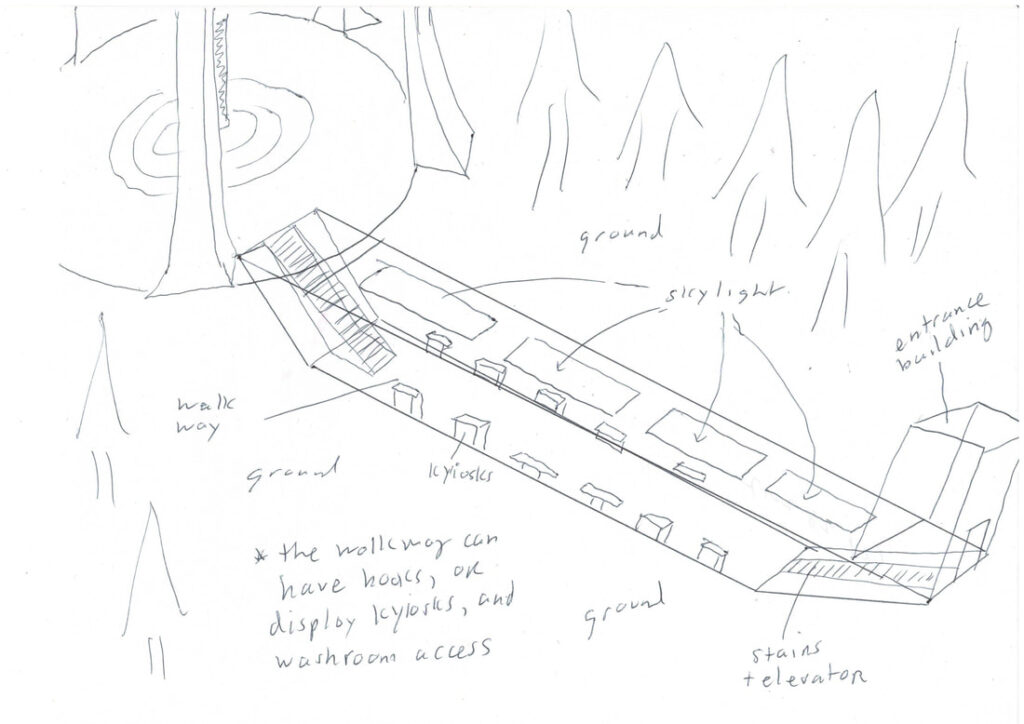
forest ( 1000 + meters square ). To get to the study hall
the student enters a small building with an underground
tunnel to the study hall. This tunnel would have sky
lights so when walking to the study hall one is under-
ground, yet bathed in light and can see perhaps the tops
of trees which line the study hall tunnel. The tunnel on each side will
have library shelves, restrooms, small meeting rooms,
3 restaurants, 3 cafes, and 3 conversation meeting rooms.
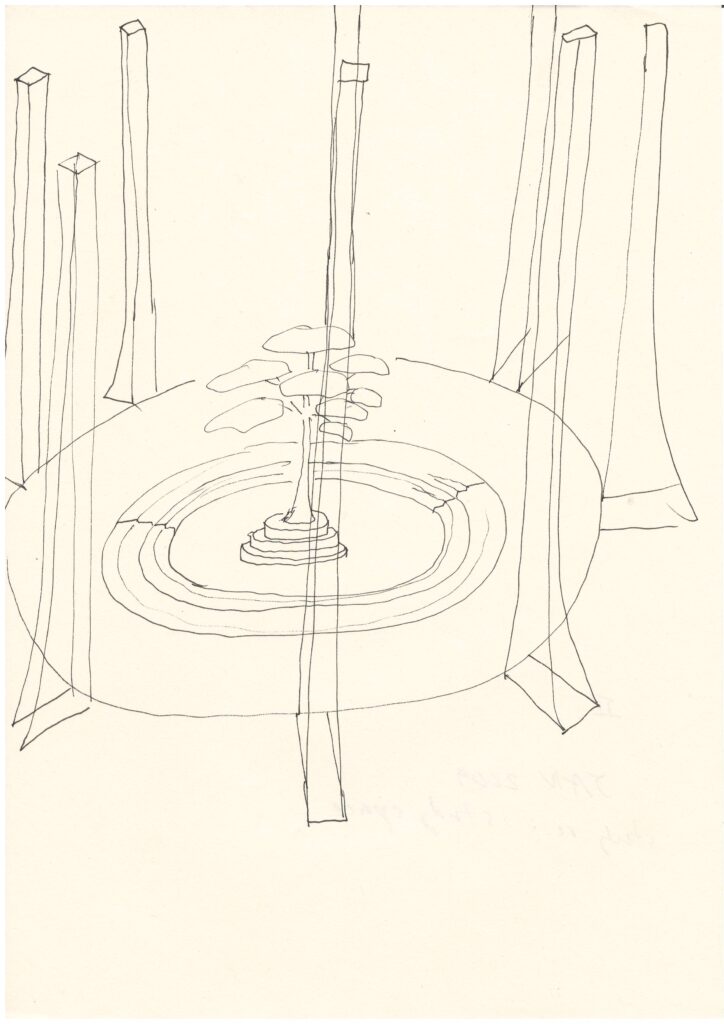
Once entering the study hall, a circular structure
of all glass with a large tree in the middle – a 100 foot
Bodhi tree. The diameter of the study hall is about 300
feet and the height about 400 feet. The entire floor of
the study hall is carpet. Around the tree are concentric
rings of thin low wide long stairs/shelves which students
can sit on and study around the tree. Around the entire glass
wall, on the edges, are couches and chairs. The Study
Place would be open 24 hours 7 days a week.
.
.
. .
.
.
.
.
.
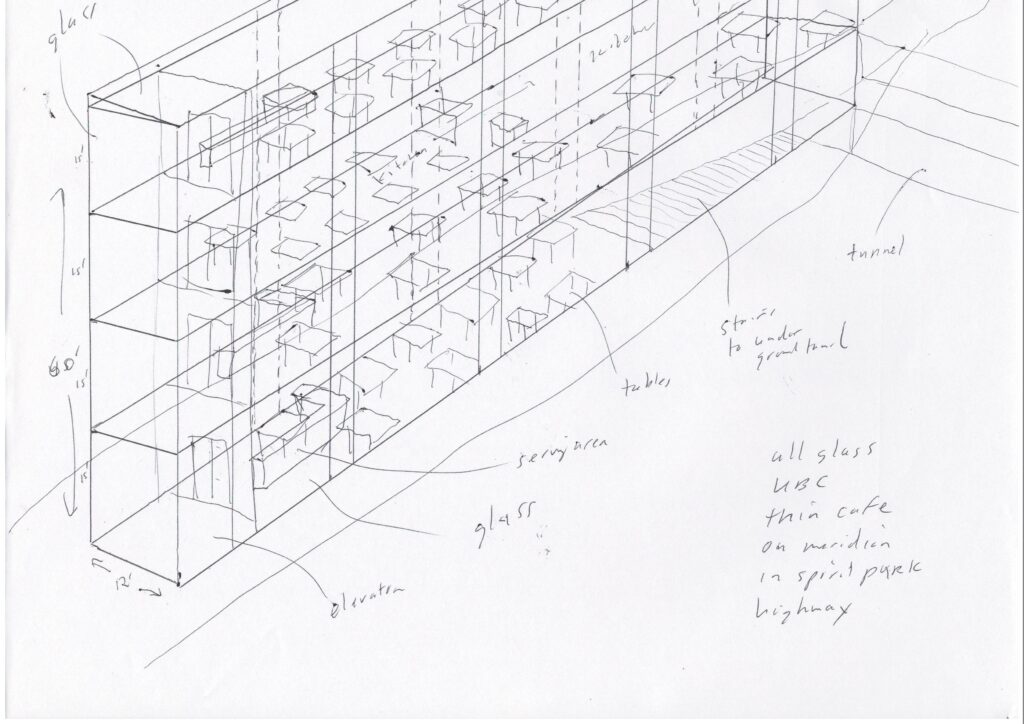

Urban Freeway Cafe
1 drawing
2015
Urban Development Commercial Architecture.
The Urban Cafe is a project to design a very long and
thin and tall all glass cafe to fit in unique urban settings
which would benefit from a social commercial space.
One such space is in Vancouver, Canada, Pacific Spirit
Park, University of British Columbia, where there is a 3/4
mile long highway with a 10 meter grass meridian in
the middle of the highway which students drive to and
the campus from the city. To have a cafe in the centre
meridian grass space would be a very unique cafe, as
the cars moving on the highway would be an interesting
visual back drop to this all- glass cafe. The entrance to
this cafe would be by a tunnel which would have an
access point on the edge of campus near the highway.
In the cafe, all the tables and interior decor would be
wood- based, to fit in with the theme of the park – trees,
and the West Coast being filled with wild nature. The
outside facade of the cafe would mostly be glass, with
white thin Corbusier pillars. The roof would also be
mostly glass. All the food cooked and served in the cafe
would be organic or natural. It would be open 24 hours
and seven days a week, 365 days a year, for agency
and increasing the livability
.
.
.
.
.
.
.
.
.
.
.
.


Proposal to City of Vancouver, Pierre Elliott Trudeau Tunnel
(Vancouver, Canada)
4 drawing, 11 in x 14 in
2013
In this series, I propose an underground bus, train,
car tunnel for 3 to 4 miles from 70th and Granville
to 16th and Granville, to increase the car traffic flow
from the suburbia bridge traffic into the city. Above
the tunnel will be a street for only pedestrians,
bicycles, a light rail monorail, and retail stores, cafes,
restaurants, mini parks and trees creating a european
type street boulevard – a Paris theme. Bellow will be
a three level tunnel, very deep, for cars and buses
and a subway. In a sense, the underground will be
designed with North American ideas of architecture
and the top with European ideas of architecture.
.
.
.
.
.
.
.
.
.
.
.
.
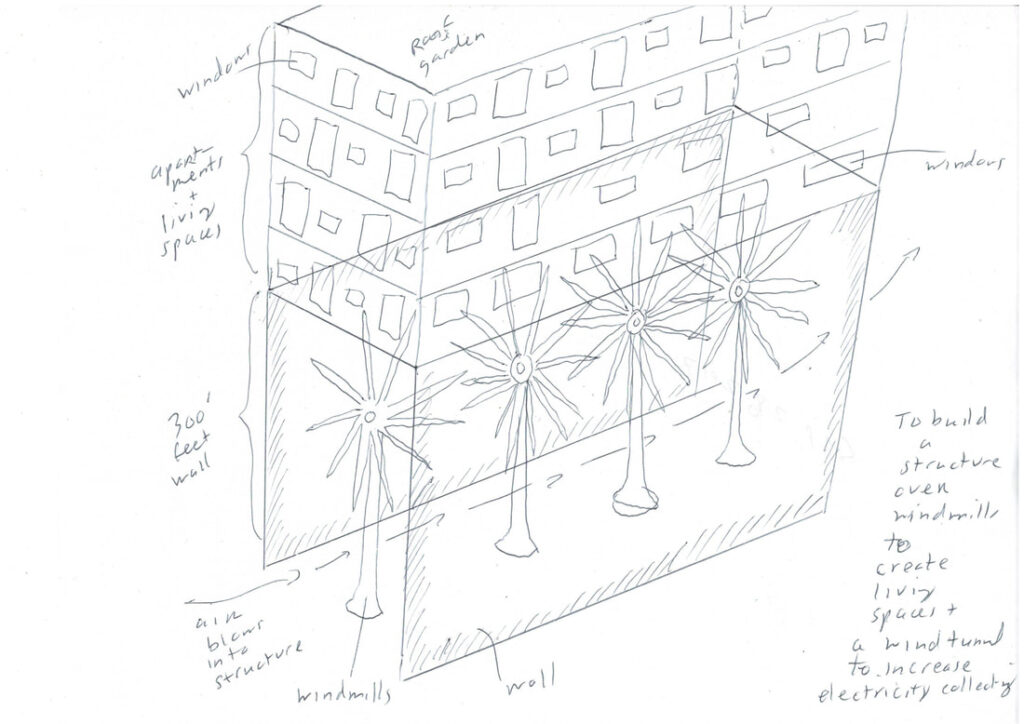
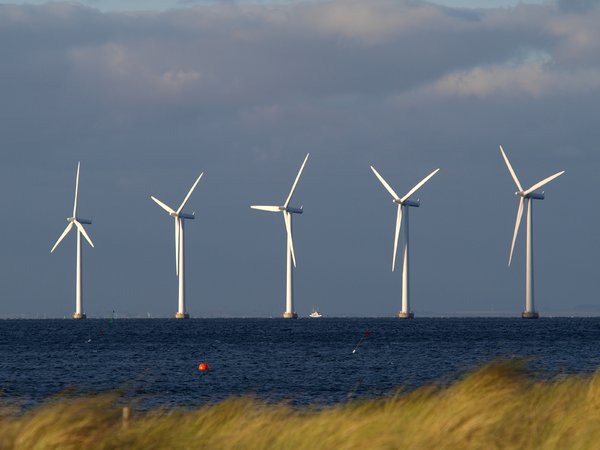
THE NEW MUSEUM OF THE ENVIRONMENT, ENERGY AND SUSTAINABILITY
2011 ( proposal in progress to the Dutch Government )
2 drawings
To build a white cube museum, a rectangular building
over and around five working windmills in a row.
This building housing the windmills would be in Holland
along the sea ride from Amsterdam to Ijumidum. To have
a venting system on each end of the building that lets
wind flow through so the windmills are moving and can
still function within this building. To build on top of the
white cube museum an apartment complex.
“New Museum of Environment and Sustainability” is a
research project about interiority and exteriority in the
context of livabliity. The environment is often defined,
described, delineated, demarked, by engineering
projects- Dams, windmills, Hydro Electric Facilities,
Nuclear Plants ; and generally speaking our reaction to
these often structures is awe with displacement: the
reaction is different than our reaction to buildings
which contain human living experience- homes,
offices, Museums, etc. Narratives in such structures
are seemingly part of the architecture’s interiors and
exterior. With engineering structures, often, their
interior have little or no narratives, and our relation-
ships to their exteriority are a psycho-social conflictual
relations of lack of intimacy and feelings of displacement
or foreign intrusion, or un/humanness, at times. While
in moments, the engineering architectural structure
can be linked to our emotions, like the Brooklyn Bridge
or Hover Dam because of its lack of intimacy that evokes
questions of humanness in a sublime fashion. The New
Museum of Environment and Sustainability, overtly and
simplistically brings the aforementioned discourses on
of interiority and exteriority and livable architecture
and engineering architecture into symbiosis; it “houses”
windmills. Thus, to build a building over and around
five windmills, transforming, morphing, engineering
architecture into living architecture. And creating
a structure collaborating with the landscape; also
creating new types of monuments to obscure the
horizon. A environmental empirical scientific outcome
of this action would be to also see if the building
over the windmills would create a wind tunnel effect,
thereby increasing the collection of wind power
and electric energy. Further, creating housing on
top of windmills would address density and housing
shortages because of population growth. This research
questions of the purpose of architecture, questions
of the Romanticism of windmills; questions of our
identity formed by engineering structures versus
buildings, and questions renewable energy and
economics in relations to aesthetics. This project
explores livability, population growth, history, identity,
architecture, environmentalism, power, aesthetics,
economics, social, Urbanism, public and private space,
and Romanticism.
.
.
.
.
.
.
.
.

The Central Business District New Euro Plan
( Proposal to Vancouver City Hall )
1 drawing
2010
Proposal: To close the four streets around the Vancouver Art Gallery – Georgia St., Hornby St., Howe St. , Robson St., from all cars and bicycles ( and active transportation- mopeds, skates, electric scooters), and design several
100 small 2000 to 5000 square foot 24 hour retail stores, mostly cafes and restaurants, with some
stores – clothes, personal, art stores, craft stores, shoes, etc, yet not any corporate
stores or services, creating a European style market area, with lots of seating, including open air food markets , outside cafes, and public art, including recreational spaces – pool halls, video arcades, bowling alleys, indoor swimming pools, indoor small zoos, indoor activities- archery, fencing, d and d rooms, laser tag, art galleries, spas, therapy places, medical services, healing gardens, clubs of all kinds, mini libraries
.August 15, 2023
.Photos of the neighbourhood Crescent, Vancouver R.C., with beautiful 100 plus year old trees, 100 plus year old Mansions.


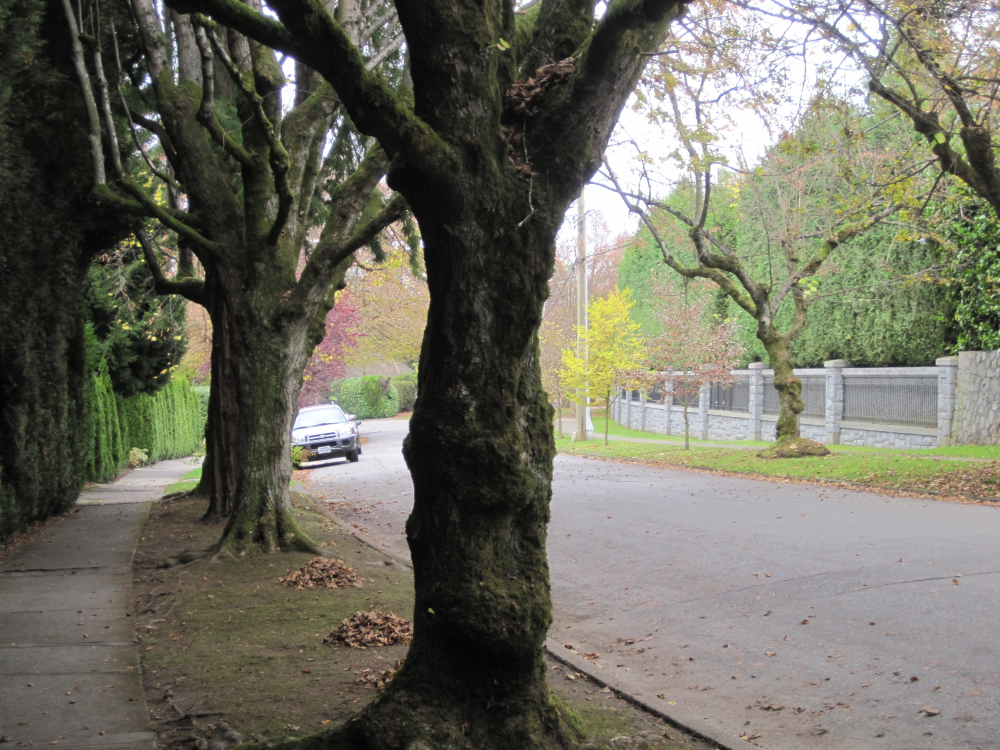
Urban Forest
Open Source ( 2023) no copyright